
My Uncle Did the Research. What He Found Changed How I See Everything.
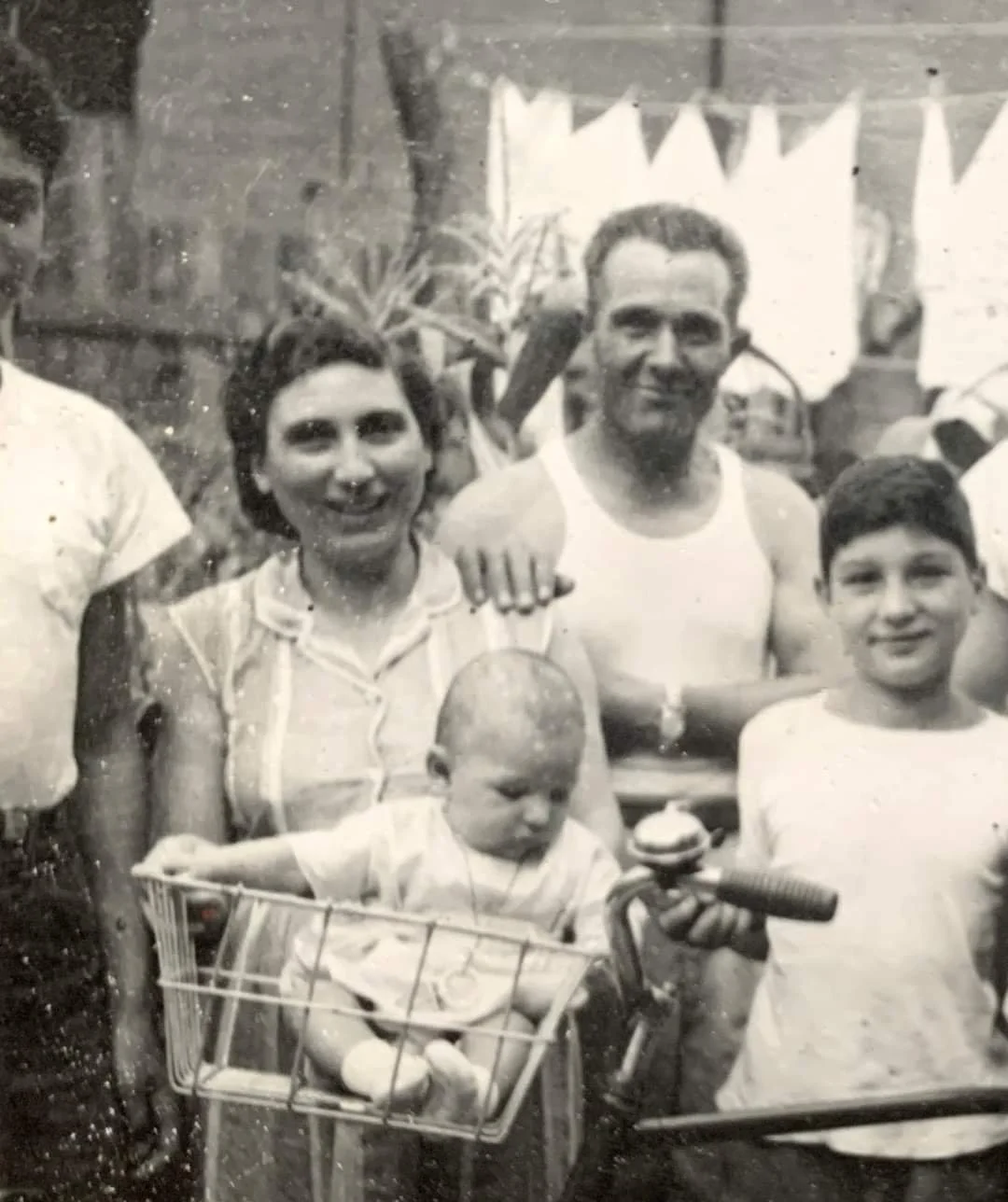
The Luciani family, circa 1965, Toronto, Ontario, Canada. Elia, Giovanni, Terenzio (Terry) and baby Tony (dad) in the bike basket.
By Emily Watts-Luciani, Locketcasts
Perfect. I have everything. Here's the full rewrite:
My Uncle Did the Research. What He Found Changed How I See Everything.
By Emily Watts-Luciani, Locketcasts
My grandmother could say the word "shit" before she could say the word "stitch."
This is how she told the story. She was a seamstress at a factory in Toronto in the late 1950s, newly arrived from Italy, trying to learn English while managing a sewing floor full of women who spoke Portuguese, Spanish, French, Cantonese and Czech. Her boss, apparently a practical man, gave her the phonetic tip that unlocked her career. She told this story her whole life, cackling every time.
Her name was Elia Clementa Luciani. She was born in a small village in Abruzzo in 1923, married by proxy at fourteen when her father died and someone had to hold title to the land, wet nurse to four babies during the Second World War, head of sewing production at a factory by the time she was forty. She taught herself six languages from library books. She kept a garden that fed everyone who sat at her table — and everyone sat at her table, as long as they ate "lots and lots" of pasta. She made baby sweaters that are still being passed down. She once patched the holes in her grandson's brand-new distressed jeans because she couldn't stand to see good fabric go to waste.
Growing up with Nonna, I absorbed something I didn't have words for until much later: the sense that someone had lived something remarkable in order for me to be here, at this place, at this exact moment in time. That my existence wasn't random. That the life I was living was built, quietly and at great cost, on the lives of people I would mostly never meet.
She was my first understanding that ordinary people are not ordinary at all.
My uncle Nick did what I only felt. He built the family tree.
He spent years tracing the Italian side of our family — births, marriages, deaths, parish records, immigration papers — going back further than any of us had thought to look. What emerged from that research was something I wasn't prepared for: the picture of a family that had barely moved in hundreds of years. The same villages. The same valleys. Generation after generation, in more or less the same place, living more or less the same way.
I am the second generation outside of that world. My grandmother's immigration to Canada in 1954 was not just a change of address. It was the first rupture in centuries of continuity.
When I understood that, I understood Nonna differently. Not just as a remarkable woman — though she was — but as someone who had stepped off the edge of an entire world and built a new one from scratch.
Then, in 2016, I did a DNA test through MyHeritage.
It came back 52% Greek.
This made no sense. My uncle had done the research. My family had been in the same corner of Abruzzo for hundreds of years. There was no Greek branch. No Greek names, no Greek records, no Greek anything. I had always understood myself to be Italian — specifically southern Italian, specifically Abruzzese.
I went looking for an explanation, and what I found rewrote everything I thought I knew about where I came from.
Abruzzo sits in the central Apennines of Italy, facing the Adriatic. Beginning in the 8th century BC, Greek settlers colonized extensive areas of southern Italy, bringing with them Hellenic civilization that over time developed distinct local forms. Wikipedia This region became known as Magna Graecia — Greater Greece. The settlers' influence left a lasting imprint on Italy, including on Roman culture. Wikipedia
The Greeks didn't just pass through. They stayed. They built cities, farmed the land, intermarried with the people already there, and over centuries their genetic signature wove itself into the population of the region so thoroughly that it never fully left. When my DNA result came back half Greek, it wasn't an error. It was just very, very old.
Abruzzo had remained isolated from the rest of Italy for long centuries — an isolation that established a balance between population and resources and favored an almost entirely self-sufficient economy. Italy Heritage That same isolation, the thing that had kept my family in place for hundreds of years, had also preserved something ancient. The Greek world that built Magna Graecia two and a half thousand years ago is still present, quietly, in the DNA of the people who never left.
My result has since been updated to southern Italian/Greek — a more accurate reflection of what the science now understands about this region. But the discovery sent me somewhere I never expected to go: back two and a half thousand years, to a shoreline in southern Italy where Greek settlers were making a new home, and forward again through every generation that stayed, survived, and eventually produced a girl in a mountain village in 1923 who would one day move to Toronto and learn to say "stitch."
That is what family history does when you follow it far enough.
It doesn't just tell you about your grandparents. It tells you about the world that made them — and the world that made the world that made them, going back further than surnames and parish records and DNA tests can easily hold.
My uncle built the tree. The tree led to Magna Graecia. Magna Graecia led to a completely different understanding of what it means to be from somewhere.
I started Locketcasts because I wanted my son to have that experience — not as a document or a chart, but as a story. The feeling of standing at the end of something long and astonishing. The understanding that ordinary people are not ordinary at all, and that the fact of his existence required remarkable things from people across thousands of years he will never see.
Every family has that story. Italian-Canadian families, French-Canadian families, families that came from Ukraine or Lebanon or Jamaica or Hong Kong — somewhere in the records, if you follow the line far enough, there is a world that no longer exists and a person who stepped out of it so that you could be here.
That story deserves to be told properly.
Get in touch at locketcasts.ca
Tags: Italian Canadian genealogy, Abruzzo family history, Italian immigration Canada, tracing Italian ancestry, family history podcast, Locketcasts, Italian Canadian heritage, birth registry research, postwar Italian immigration Toronto
